CSEL: Measuring Teacher Beliefs About Classroom SEL
Developed a scale measuring teachers' beliefs about classroom SEL with 2,097 teachers. Factor analysis revealed three dimensions (management, culture, relationships) that predict teacher well-being and correlate with emotional intelligence.
SEL’s classroom success depends on teacher buy-in—teachers are the primary implementers. Yet measuring what teachers believe promotes effective classroom SEL is challenging, especially where SEL is nascent. We developed a scale measuring teachers’ beliefs about factors that promote Classroom Social and Emotional Learning (CSEL), validated with 2,097 teachers in India.
What it measures
Three validated factors emerged from analysis:
- Healthy classroom management — beliefs about structure and discipline
- Inclusive classroom culture — beliefs about equity and belonging
- Supportive student relationships — beliefs about teacher-student connection
Each factor captures distinct but interrelated aspects of how teachers conceptualize their role in promoting classroom SEL.
Approach
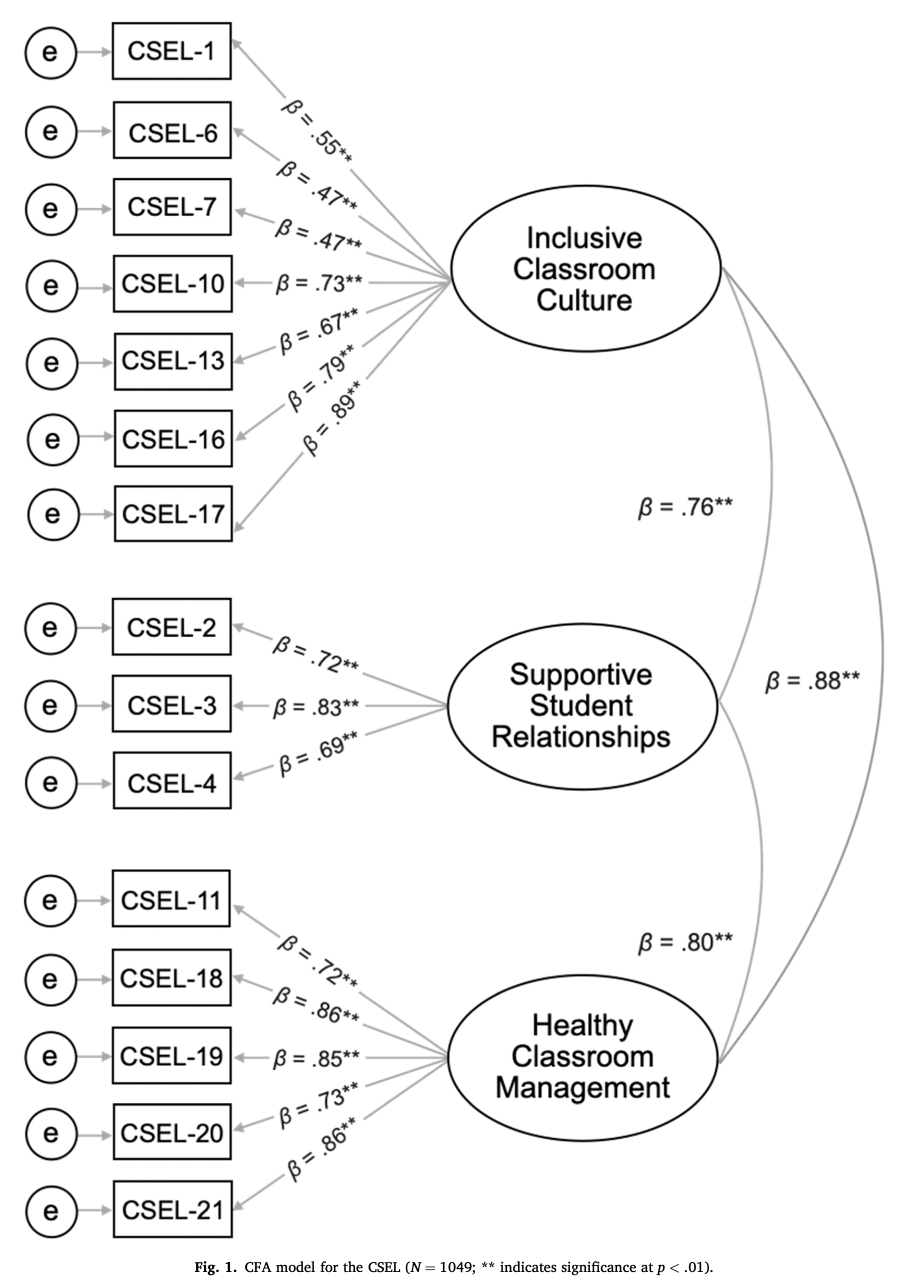
Developed by identifying key factors from SEL implementation literature, generating items grounded in classroom practice, and validating through exploratory and confirmatory factor analysis. Convergent and discriminant validity established by testing relationships with theoretically related (emotional intelligence, well-being) and unrelated (stress) constructs.
Results
Three-factor structure validated with strong internal consistency (α > 0.80 for all factors). Teacher beliefs positively predict mental well-being (predictive validity). Strong correlation with emotional intelligence (convergent validity). Inverse relationship with perceived stress (discriminant validity). Gender-invariant—scale functions equivalently for male and female teachers.
Why it matters
Teacher beliefs are measurable, structured, and consequential. The three-factor structure aligns with SEL implementation research while revealing how teachers conceptualize their role. Practical implications: target specific belief dimensions (management, culture, relationships) in teacher training, track shifts in beliefs as programs scale, and recognize that beliefs predict well-being (bidirectional relationships). For psychometrics, this demonstrates construct-driven scale development: start from implementation theory, operationalize beliefs as measurable constructs, validate through convergent/discriminant relationships.