Equilibrium in Empathic Response Predicts IWAH
Used polynomial regression with response surface analysis on 634 Indian adolescents to show that equilibrium in empathic concern and personal distress predicts identification with all humanity, while directional disequilibrium (EC>PD) provides no additional benefit.
Empathy predicts prosocial behavior, but the nuances—particularly how empathic concern (other-oriented care) and personal distress (self-oriented discomfort) interact—remain underexplored in adolescents. We examined whether empathic equilibrium (balanced EC and PD) or directional disequilibrium (EC > PD) better predict Identification with All Humanity (IWAH), a superordinate identity linked to reduced prejudice and prosociality. Studied 634 Indian adolescents (ages 11–16).
What we tested
Whether the balance between empathic concern and personal distress predicts global social identity. Used polynomial regression with response surface analysis (PRRSA) to model empathic equilibrium vs. disequilibrium—moving beyond simple interaction terms to capture nonlinear relationships.
Approach
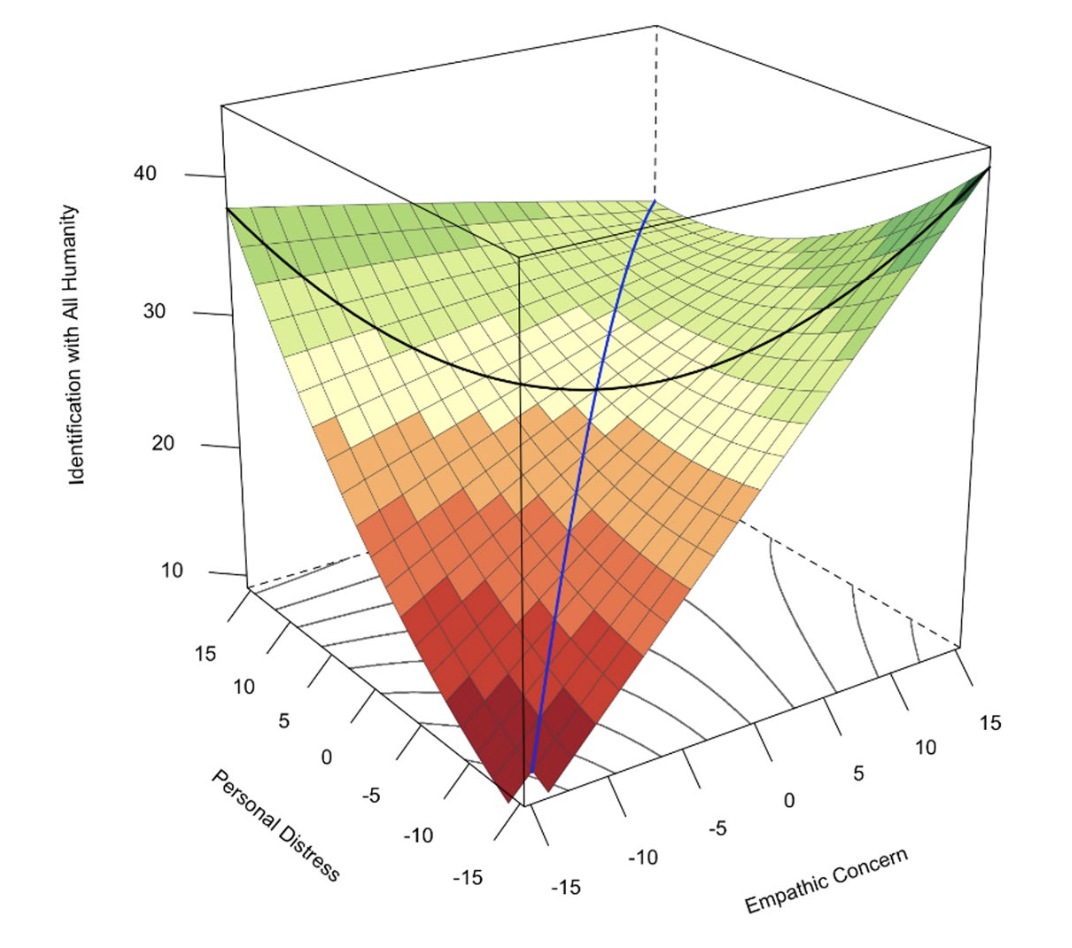
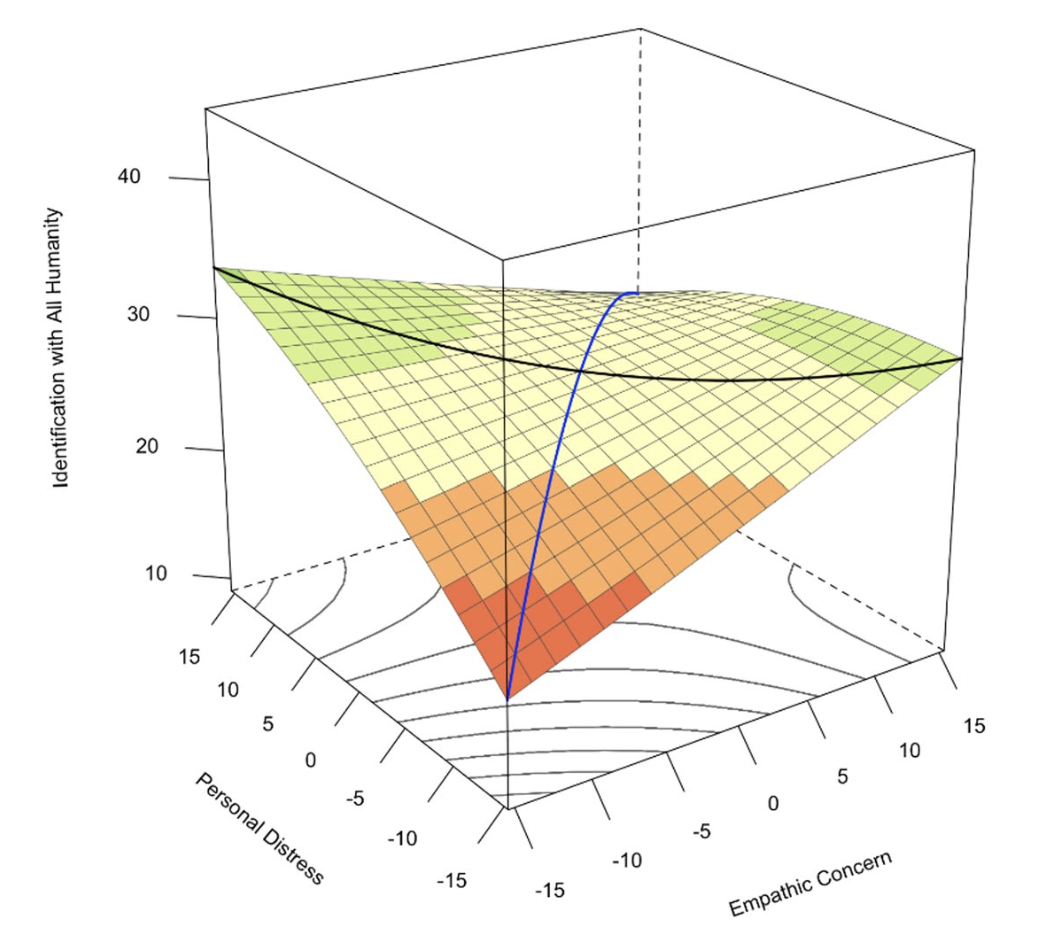
PRRSA tests whether outcomes are highest when EC and PD are balanced (equilibrium) or when one exceeds the other (disequilibrium). Response surface visualization shows how IWAH changes as EC and PD vary jointly.
Results
Equilibrium in EC and PD predicts higher IWAH—adolescents with balanced, high EC and PD show stronger identification with all humanity. Directional disequilibrium (EC > PD) doesn’t provide additional benefit beyond equilibrium. No age differences observed in 11–16 range. Findings hold in Indian adolescents, an understudied population in empathy and global citizenship research.
Why it matters
This challenges the intuition that maximizing empathic concern while minimizing personal distress is optimal. Instead, balanced empathic responding—where individuals experience both concern for others and awareness of their own emotional reactions—may be most adaptive for inclusive identity. For global citizenship education: empathy training should target balance, not just maximize concern. Personal distress isn’t purely maladaptive—when balanced with concern, it may reflect engaged emotional processing. Programs aiming to build inclusive identities might focus on helping adolescents maintain balanced empathic responding that sustains engagement without overwhelming.